Scoring runs
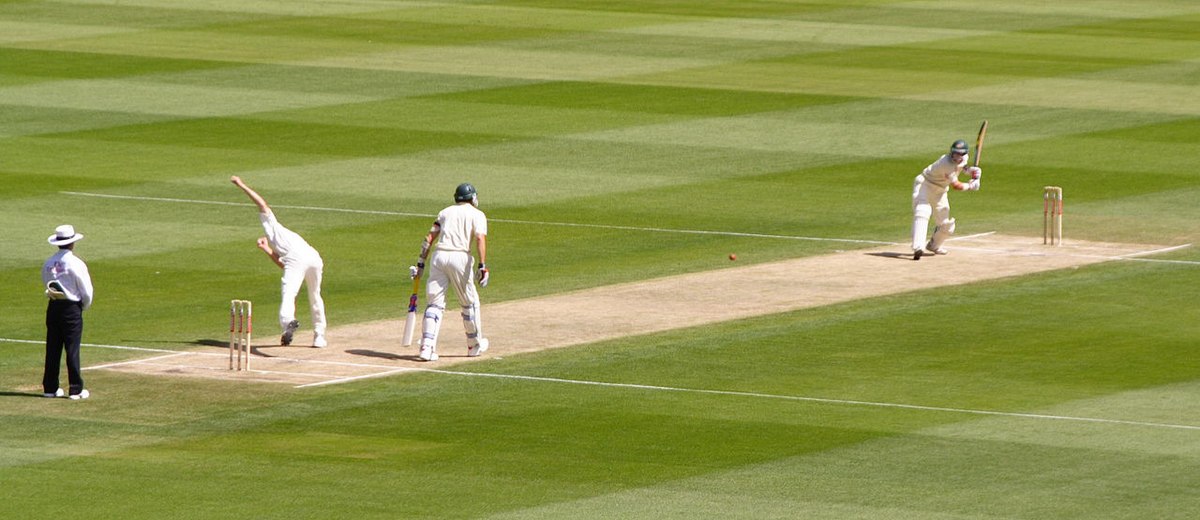
Two batters occupy the crease at either end of a 22-yard pitch. After hitting the ball they can run between the creases, one run per completed length. A ball that reaches the boundary along the ground is four runs automatically; one that clears it on the full is six.
- One run per completed length between the creases
- Four for a ball crossing the boundary along the ground
- Six for a ball clearing the boundary without bouncing
- Extras — byes, leg byes, wides and no-balls — are added to the total
Getting out
There are ten ways to be dismissed, but four account for almost everything you will see. When ten of the eleven batters are out, the innings ends — a batter cannot bat alone.
- Bowled — the ball hits the stumps
- Caught — a fielder catches the ball on the full
- Leg before wicket — the ball would have hit the stumps but hit the leg first
- Run out — the stumps are broken while batters are between creases
- Stumped, hit wicket, and rarer dismissals make up the rest
Bowling and the over
Bowlers deliver six balls — an over — from one end, then a different bowler delivers the next over from the other end. The arm must not straighten during delivery; bending it is a throw and illegal. Fast bowlers work at 140 km/h and above, spinners at half that speed with lateral movement off the pitch.
- Six legal deliveries make an over
- No bowler may deliver two overs in a row
- A wide or no-ball concedes a run and must be bowled again
The three formats
Cricket's formats differ so much they are almost separate sports. Test cricket lasts five days with two innings each and no limit on overs. One-day internationals give each side fifty overs. Twenty20 gives each side twenty, and finishes in about three hours.
- Test — five days, two innings each, draws possible
- ODI — 50 overs a side, one innings each
- T20 — 20 overs a side, roughly three hours
The field
The playing area is oval and unusually variable — there is no standard size. Fielders are placed by the captain in positions with a vocabulary all their own: slip, gully, point, cover, mid-on, fine leg, third man. Placement is the captain's main tactical lever, since only the bowler and the wicketkeeper have fixed roles.
The toss and the conditions
A coin toss decides who bats first, and in longer formats it genuinely matters: a pitch deteriorates over five days, cracking and taking more spin, so batting last is usually hardest. Weather, humidity and the age of the ball all change how much it swings and seams.
The officials
Two on-field umpires stand at the bowler's end and at square leg. A third umpire reviews line decisions and catches on video, and teams may formally challenge decisions through the Decision Review System, which uses ball-tracking and edge detection.
