The objective and the circle
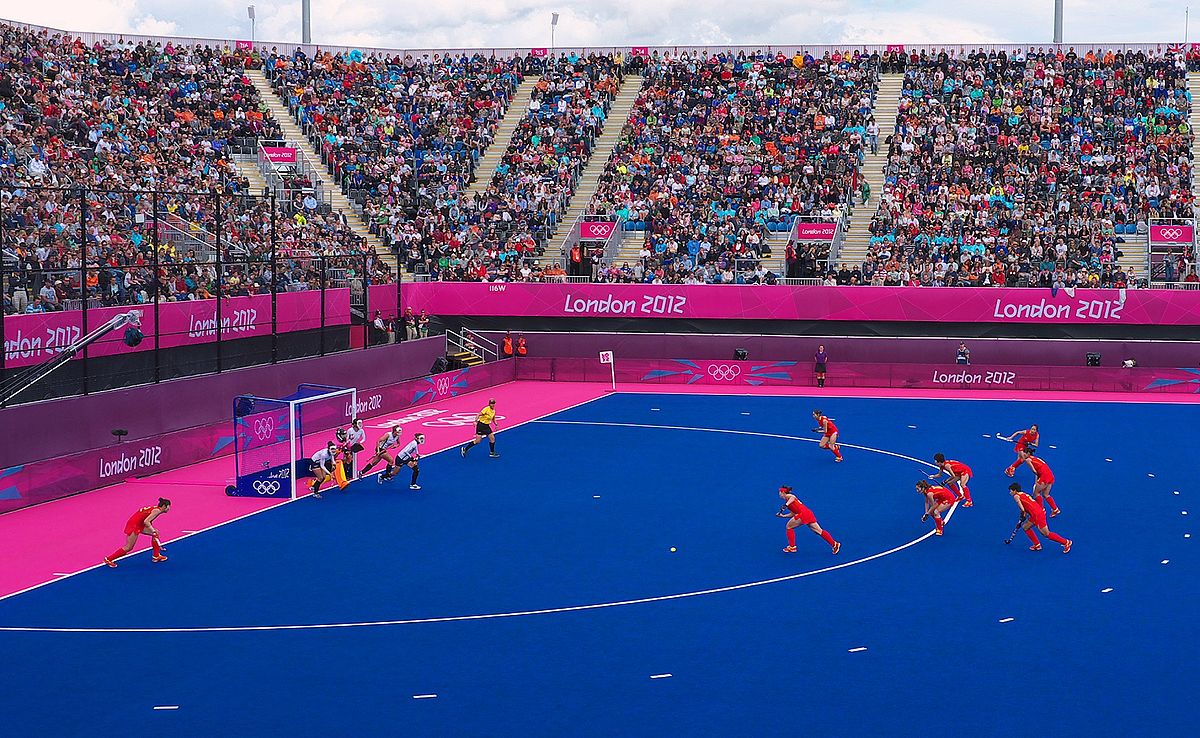
A goal counts only if the ball is played by an attacker from inside the shooting circle — a D-shaped area 14.63 m from the goal. A shot struck from outside the circle does not count even if it goes in, which is why almost all attacking play is designed to get the ball into that area cleanly.
- Goals must be touched by an attacker inside the circle
- The circle radius is 14.63 m from each goalpost
- Goals are 3.66 m wide and 2.14 m high
_-_2024-07-27_-_28.jpg/1200px-Match_Hockey_Grande_Bretagne_x_Espagne_Jeux_Olympiques_2024_Terrain_1_Stade_Yves_Manoir_-_Colombes_(FR92)_-_2024-07-27_-_28.jpg)
The stick
Only the flat face of the stick may contact the ball. Using the rounded back is a foul, so players use the reverse-stick technique — turning the stick head down and playing the same flat face from the other side. Sticks are curved, with a strict limit on how much bow is allowed.
- Only the flat side of the stick may touch the ball
- The stick may not be raised dangerously near an opponent
- Maximum stick length and bow are regulated
Match structure
Modern hockey is played in four quarters of fifteen minutes, replacing the old two halves of thirty-five. The clock stops for penalty corners and for goals, so the sport has become substantially faster. Substitutions are unlimited and rolling — players come on and off continuously without stopping play.
- Four 15-minute quarters with two-minute breaks
- Unlimited rolling substitutions
- The clock stops for penalty corners and goals
Fouls
Most fouls concern the stick and the body. Obstruction is unique to hockey: you may not shield the ball from an opponent using your body, which forbids the shielding that is entirely legal in football.
- Obstruction — using the body to block an opponent from the ball
- Foot — the ball touching a field player's foot or body
- Dangerous play — raising the ball or the stick unsafely
- Backsticks — using the rounded side of the stick
The penalty corner
A foul by the defending team inside its own circle concedes a penalty corner, the sport's most dangerous set piece. The ball is injected from the backline, stopped at the top of the circle, and struck at goal while up to five defenders charge out from behind the goal line. The drag flick — scooping the ball at speed rather than hitting it — has become the standard weapon.
- Up to five defenders may be behind the goal line
- The ball must leave the circle and be stopped before a shot
- A first hit at goal must not exceed backboard height; a flick may be raised
Cards and the penalty stroke
Hockey uses three cards rather than two, and suspensions are timed rather than absolute. A deliberate foul that prevents a certain goal concedes a penalty stroke — a one-on-one push from 6.4 m with the goalkeeper on the line.
- Green card — two-minute suspension
- Yellow card — five minutes or more
- Red card — permanent removal from the match
- Penalty stroke — awarded for a foul that denies a probable goal