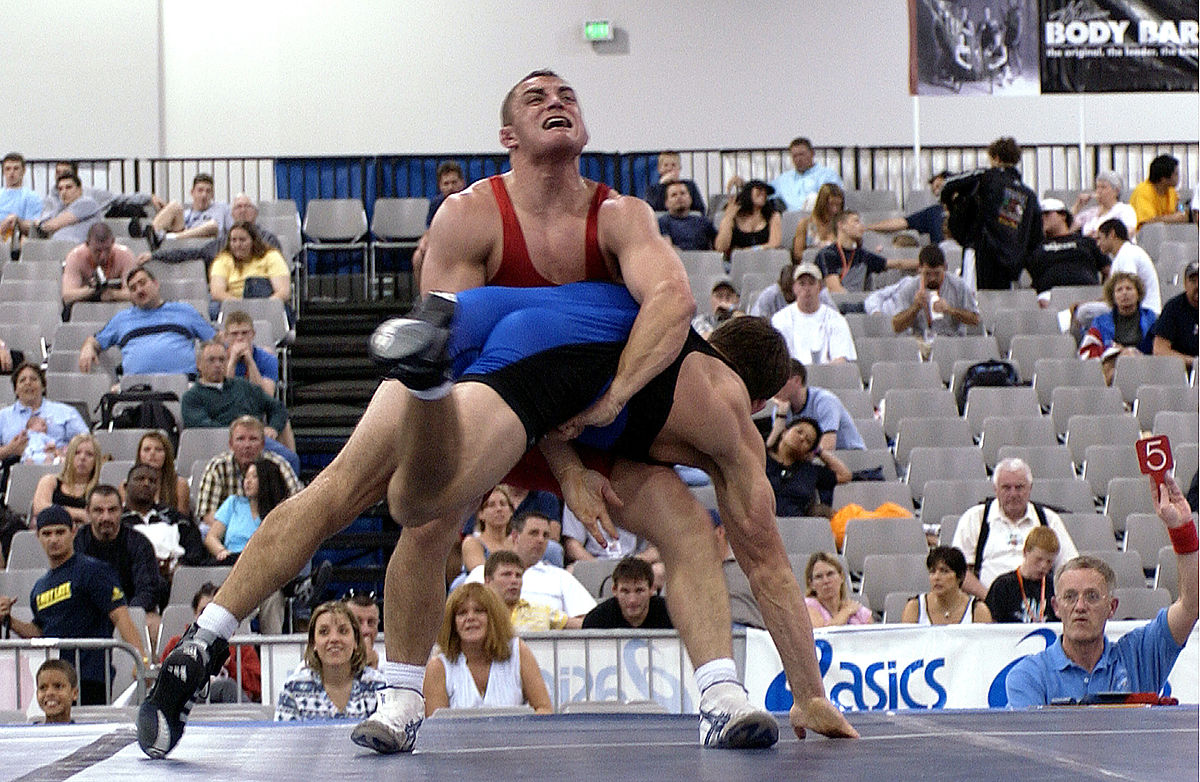
The two Olympic styles
Freestyle and Greco-Roman are separate disciplines with separate medals. Greco-Roman forbids any hold below the waist and any use of the legs to trip or lift, which forces everything upstairs and produces the sport's spectacular throws. Freestyle allows leg attacks, so it is built around low shots at the knees and ankles.
- Freestyle — legs may be attacked and used; contested by men and women
- Greco-Roman — no holds below the waist, no leg trips; men only at the Olympics
- Folkstyle — the American collegiate variant, scored differently again

Winning by fall
A pin, or fall, ends the match immediately regardless of the score. Both of the opponent's shoulder blades must be held in contact with the mat long enough for the referee to confirm control — usually one to two seconds. It is the only outcome in the sport that makes the points irrelevant.
Scoring points
If nobody is pinned, the match is decided on points across two three-minute periods. Points are awarded for changes of control and for exposing the opponent's back to the mat.
- Takedown — 2 points for bringing the opponent down and controlling them
- Exposure — 2 points for turning their back towards the mat
- Throw of grand amplitude — 4 or 5 points depending on control
- Escape and reversal — 1 or 2 points depending on style
- Push-out — 1 point for forcing the opponent from the circle
Technical superiority
A lead of ten points in freestyle, or eight in Greco-Roman, ends the match immediately. This prevents lopsided contests from continuing and rewards aggression, since a wrestler who is comfortably ahead has an incentive to keep attacking rather than stall.
Passivity and stalling
Wrestling penalises inactivity, because a defensive wrestler who never engages could otherwise protect a narrow lead. A wrestler warned for passivity gives their opponent a shot clock, and failure to score within it concedes a point. In Greco-Roman, passivity leads to a par terre position where the opponent starts on top.
Weight classes and the weigh-in
Wrestlers compete within tight weight categories, and the sport has historically had the most extreme weight-cutting culture of any Olympic discipline. Rules were tightened after deaths in the 1990s: weigh-ins now happen closer to competition, and dehydration methods such as saunas and rubber suits are banned.